
August 2026: June 2026 corporate results reflect an acceleration in growth
In this newsletter, we will discuss the corporate performance for the quarter ended June 2026 for the BSE-500 ex-financials, which is what we usually do once all the quarterly results have been reported. Below we present the revenue and EBIT growth of the sample set, which consists of 360 companies for whom we have comparable numbers for 12 quarters. These 360 companies represent ~93% of the market capitalization of the BSE non-financials. We have presented the numbers for all the companies in the sample and also the numbers excluding the volatile Energy sector, which was particularly badly hit because of higher oil prices prevailing due to the Iran war.

Download Revenue Growth data (Excel Spreadsheet)

Download EBIT Growth data (Excel Spreadsheet)
For the sample set ex-energy, the revenue growth which was hovering in the 6 to 8% range from Sep 2023 to Sep 2025, has accelerated significantly over the last three quarters. Further, there seems to be some acceleration even over the last three quarters with the June 2026 quarter recording stellar revenue growth of 20%. EBIT growth has also picked up in the last three quarters – while growth was in low double digits for Mar-2026 quarter, the June 2026 number is once again stellar at 20%.
When we look back in time, it is rare to find a period in the last decade when the growth in revenue for the BSE-500 ex-financials ex-Energy was this high, barring the growth witnessed during post covid on a low base caused by disruptions. This augurs well for the corporate sector, which has been struggling a bit over the last few years.
We now look at the deposit growth and loans growth over the last 20 years.
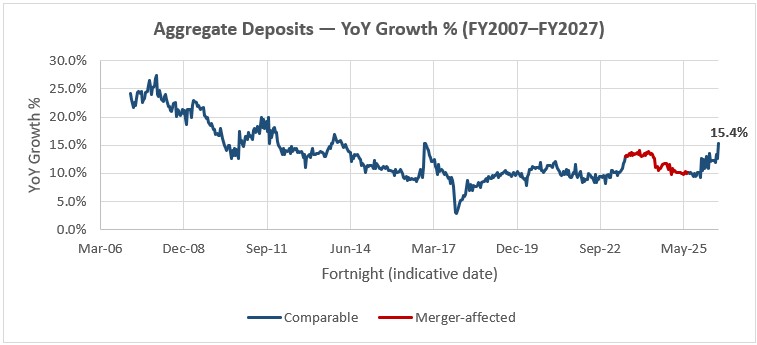
As we can see, deposit growth currently is close to the highest it has been in the last decade. This is of course helped by the large FCNRB deposits garnered by Indian banks after the RBI stimulus to these deposits, which we discussed two months ago in our newsletter. The only exception is FY2017 when demonetization led to large deposits of currency, which was subsequently withdrawn from bank accounts and so the deposit growth a year later was sharply lower. The current growth rates are lower than those witnessed two decades back, but we need to bear in mind that inflation in the prior decade was higher than in this decade. Higher inflation pushes up nominal GDP growth and hence nominal deposit growth.
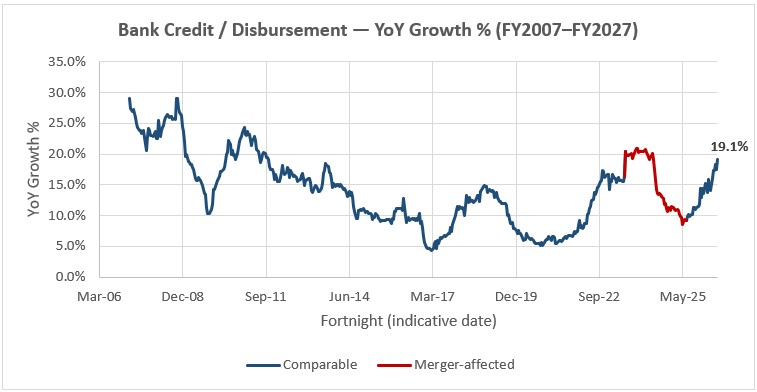
Credit growth too is high in comparison with history. While the FY2024 credit growth looks higher, that is due to the inclusion of HDFC Limited’s loan book upon merger with HDFC Bank. This event did not affect the deposits growth so much because HDFC Limited’s deposits were very low in relation to their loan book. If we adjust for this, then the latest number of 19.1% credit growth is also the highest in a decade.
The high automobile growth which we wrote about last month, the good corporate results for the June quarter and the high credit and deposit growth, all suggest to us that the Indian economy is on a strong revival path. The stock market for some reason, does not seem very convinced as the median stock in the BSE500 is still down 31% from its All Time High (ATH) and 21% of the stocks in the BSE500 are down 50% or more from their ATHs. Perhaps the market is waiting to see if this growth that we are witnessing now will continue in the October to December quarter, when the base is higher (GST cuts came into effect on 22 September 2025.
The corporate results over the last few quarters and the credit and deposit growth, which is continuing into July 2026, gives us hope that the worst may be behind for the Indian economy and investors can possibly look for robust corporate growth going forward. While we do acknowledge that even after the median stock has gone down 31% from its ATH, there remain some pockets of overvaluation in the market, we remain confident of our portfolio, where most of the stocks are trading in the undervaluation zone compared to their history.