
July 2026: Automobile sector reporting growth not seen for almost a decade
We want to focus this newsletter on the growth trends in recent months. In our earlier newsletters, we have reported that corporate growth has been picking up for the last few quarters. We now look at the aggregate auto sector numbers as a proxy for real (inflation adjusted) growth in consumption in the economy as also the impact of the GST cuts, which was substantial for the auto sector. Another reason for favouring the auto sector is that here we get reliable high frequency data which is comparable across decades. The auto sector also makes up almost 50% of the manufacturing sector in India thus underlining its importance for the economy.
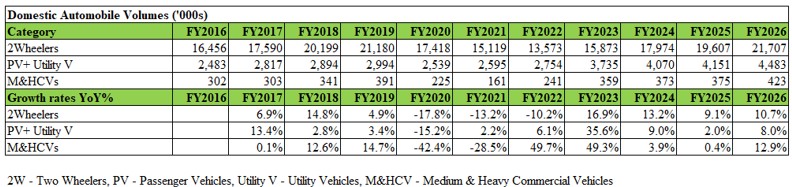
First, we look at the annual data of total domestic volumes sold in 2-wheelers, passenger cars (including sports/utility vehicles) and medium and heavy commercial vehicles (MHCVs) segments over the last 10 years.
Download Domestic Automobile Volumes (‘000s)- Financial year wise data (Excel spreadsheet, .xlsx)
As we can see, FY2019 was the last peak for the 2-wheeler sector. After that year, sales volume declined and it is only in FY2026 that total 2-wheeler volumes surpassed the FY2019 sales. For passenger cars too, FY2019 was a short-term peak though this level of sales was exceeded in FY2023, and FY 2026 volumes are 50% higher than FY2019 volumes representing a growth of 5.9% pa. FY2023 growth for cars and UVs is high but that is on a low base affected by covid. This is a rather simplistic analysis because it doesn’t take into account different segments of automobiles, but it gives us an idea of general direction. Total MHCV sales also peaked in FY2019, and it is only in FY2026 that the FY2019 peak has been surpassed.
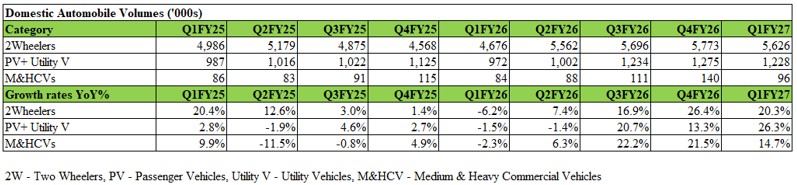
Now we turn our attention to the quarterly numbers to get a better near-term understanding of automobile sales.
Download Domestic Automobile Volumes (‘000s)- Quarterly wise data (Excel spreadsheet, .xlsx)
Here we see three quarters of sustained growth which is in fact picking up at the margin in the March 2026 and June 2026 quarters. We need to go back several years to remember when we saw such high growth. Also, it is not a one quarter wonder – we have now seen sustained growth for three quarters, and we hope that this momentum will sustain.
It is heartening to note that the efforts of the government and the RBI to stimulate the economy through GST cuts and income tax cuts for those earning sub 12 lakhs income as also interest rate cuts and CRR cuts are working. We are seeing very robust growth, something that we have not witnessed for many years. Some of this is also visible in the early corporate results and we will report more on that next month when all the results have been declared.
All in all, there seems to be renewed momentum in the economy, and one hopes that this will eventually lead to a revival of the private sector capex cycle which has been absent for several years. Some of the automobile players like Maruti and Eicher have added capacity and have announced further capacity additions, and we hope this trend repeats across sectors.
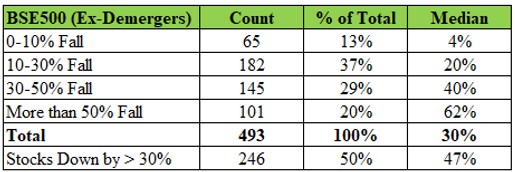
Meanwhile although the market has bounced back from the lows of 31 March 2026, it remains subdued. Below we present where the different constituents of the BSE500 are trading with respect to their respective All Time Highs (ATH).
Download BSE500 (Ex-Demergers) data (Excel spreadsheet, .xlsx)
As we can see, the median stock is down about 30% from its ATH and 20% of the stocks in the BSE500 are down 50% or more. So, Mr. Market continues to be in a bad mood. Part of the reason is that the valuations were extremely high near the peak. In our August 2024 newsletter we had noted that 47% of the BSE500 constituents were trading at a Trailing Twelve-Month Price to Earnings ratio of more than 50 (a very high PE). What is interesting to note from our own automobile data above is that September 2024 and the quarters after that, were very weak quarters for automobile volumes. We have shown in a prior newsletter that corporate growth in September 2024 quarter was quite weak. So, the irony is that when growth was poor, the market was very strong, and now that growth is strong, the market is weak. This economic momentum will face its first test in the December quarter when the base will be higher. The monsoon remains the other worry with some fears expressed of a severe El Nino effect this year. The shortfall in June was severe though July has been better. We wait to see how the monsoon pans out in the coming months.
How does all this impact our portfolio? The higher automobile sector growth and the corporate results declared so far, confirm a three quarter uptrend in corporate results and the economy, with growth rates nearing levels not seen for a decade, bar some pandemic related bumps on a low base. The economy had its last cyclical peak in FY2019 and eight years later, it could be time for the economic cycle to turn upwards. Credit growth too is in the 16% range, which is a multi year high. This should help banks. Also the initial FCNR(B) deposit collections have been robust. The RBI Governor Sanjay Malhotra, said on 26th July that banks had mobilized nearly $32 bn under recent dollar-inflow schemes, driven largely by FCNR(B) deposits. This augurs well for banks who get the benefit of high deposits. The Cash Reserve Ratio of RBI is currently at 3%, equaling the lowest in history which was during covid. Thus liquidity is ample to support higher credit growth for the economy. Some of this is also visible in the June quarter results of the rating companies who reported 20% plus operating profit growth. The consumer companies are also reporting much better results than in recent years.
If we are indeed sitting at the beginning of a new private sector capex cycle, it could be a golden opportunity for investors, particularly those invested in businesses which are still available at reasonable valuations. We are sitting on less cash in our portfolio than for at least two years and maybe more. If you are looking to invest over a long term horizon, this is a good opportunity to add to the portfolio.