
September 2026: Policybazaar- solving for the consumer and the insurance company
On 23 September, 2026 IRDAI, the insurance regulator released a draft consultation paper which proposes steep cuts in the insurance commission paid by insurance companies to all parties who sell insurance. On the next day PB Fintech ( the owner of PolicyBazaar and part of our portfolio) fell by about a third of its value on the exchanges, hitting circuit breakers almost through the day. This draft consultation paper is open for comments till 25 October, 2026. The recommendations are not final yet and may undergo changes after the consultation process. The proposals, once finalized, are expected to become operational next financial year and the management does not expect any material impact in the current financial year ending March 2027.
To understand the whole issue better, we need to first understand the problem set that Policybazaar (PB) is trying to solve for. We list them below:
- Insurance penetration in India is low: Insurance penetration is typically measured as a % of GDP – given that it not only covers the value of lives, but also the value of property. India’s total insurance penetration stood at 3.7%, compared to the global average of 7.3%. In terms of health insurance, which is considered a necessity, merely 58 Cr. or 41% of India’s population is covered. If we were to exclude government and group health cover, only 6 Cr. individuals have their own health cover. Similarly, penetration of term insurance is only 13% of addressable population.
- Industry prefers to sell savings and investment products rather than protection products (term insurance). An estimated 80-90% of the insurance products sold in india are savings and investment products which pay higher commissions (with only small protection coverage). In developed markets like US about 70% of the insurance sold is through term insurance. Term insurance involves paying a small premium to protect your life (but you get nothing back at the end of the term if you survive), while savings and investment insurance products have a small component of term protection and a large component of savings.
- Indian insurers struggle to earn a decent profit: In FY26, the entire general insurance industry reported a profit after tax of only Rs. 953 Cr. To put this into context, ICICI Lombard and Go Digit reported profits of Rs. 2,772 Cr. and Rs. 544 Cr. respectively. The reason for industry profits being lower than ICICI Lombard’s is that many insurers reported losses and large losses at that. In certain years like 2022, the industry has even made losses on an aggregate basis.
- Insurance is sold not bought: This is true globally but even more so in a developing market like India. Deloitte’s 2026 research talking about life insurance in the US says “stated needs from consumers is high but purchase follow through can be decidedly weak” reinforcing life insurance’s reputation as a product that is sold not bought. Non-life insurance can have some element of pull though.
The ways in which Policybazaar tries to solve some of these problems
Policybazaar was founded in 2008 and for the first 15 years made losses until it finally made a profit in FY2024. That money was spent building what did not exist in India: a trusted place where people come on their own to buy insurance. Today it has about 93% market share of online insurance distribution, and about 80% of its business comes organically rather than through paid online marketing. Its advertising spend, over ₹1,000 crore a year, is more than that of India’s six largest general insurers combined, and its advertising largely promotes the idea of being insured.
How does PB solve for the consumer?
a) It offers side-by-side comparison of over 1,000 plans from 53 insurers, at prices that match the insurer’s own website;
b) advice from trained advisors, including home visits for complex products;
c) one-month free cancellation window; and
d) most importantly, help at claim time, with on-ground claims support in 250+ cities and a relationship manager for each claim. It supported about 70,000 health claims in April–June 2026 alone. It also chooses not to sell traditional participating products, which it believes are poor value for customers.
How does PB solve for the insurer:
PB solves for the insurers by providing better quality customers. As customers fill in their own forms, disclosures are more honest, which means fewer surprises at claim time. By our analysis, PB’s health customers have a claims ratio of about 58%, against about 78% for the industry. It brought in roughly 40% of all new lives added to retail health insurance in FY26, and new, younger customers claim less. It also shares data and uses technology to catch fraud – 3.6% of Life Insurance cancellations were processed, based on the PB Fraud Detection framework, saving insurance companies’ fraudulent claim cost. For these reasons we believe it is one of the most profitable channels for insurers. Insurers that left it around 2020 to sell on their own have since returned giving further evidence of how PB is solving for the insurer.
What has the regulator proposed in its draft consultation paper
Currently, there are no caps on commissions paid out by insurers. Some of the key measures proposed are: a) Caps on commission paid for each product in the insurance space b) Lower overall expense limits for insurers, implemented over a 5 year period beginning FY2028 c) All incentives paid to the distribution channel to be subsumed within the caps provided d) No forced bundling of insurance with loans e) Insurance prices to be shown to a customer before asking for their phone number and other details.
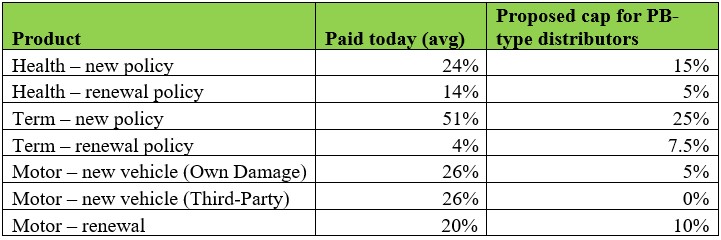
Source: IRDAI Consultation Paper; Kotak Institutional Equities
Download Insurance product data (Excel Spreadsheet)
The likely impact of these measures
Insurance is largely a push product, and more so in a developing economy like India where financial literacy is poor. While we understand the regulator’s concern that insurance commissions are growing much faster than insurance premiums, such steep cuts in insurance commissions will likely impact the viability of many parts of the distribution channel. PB management estimates that the net present value of their non-life insurance business could fall as much as 60% if these guidelines were to come into effect in toto. They assess that the impact on the term insurance part of the business is not material as higher renewal commissions offset lower upfront commissions. The company can respond in multiple ways. 80% of their costs are variable and they have indicated that they may slow down hiring and advertising in response to these changes proposed by the regulator. Moreover, they have 5000 cr of cash on their balance sheet to weather out this storm.
If commissions shrink for PB, they can perhaps try to charge for other services that they provide to insurers, like garage services, access to a narrow network of trusted hospitals, claims assistance services, analytics, technology-enabled servicing and other solutions. Clearly the insurers would be keen to find some other way to compensate PB since it is such a valuable partner to them, providing high quality customers and also importantly younger, new to insurance customers. The management has also spoken about the possibility of entering the reinsurance segment as a manufacturer and this is another area where insurance companies may choose to compensate them for the value they bring to the table.
Another possibility that exists is that the IRDAI may issue guidelines for Managing General Agents(MGA) at some point in the future. An MGA is an intermediary to whom the insurance company delegates underwriting authority. An MGA can perform various functions like underwriting, pricing the product, handle claims up to agreed limits and can appoint sub producers. In many senses given all the services that PB provides, it would we well suited to becoming an MGA. This would help them circumvent the rules meant for a distribution entity and thus earn higher profitability. We are not aware if this is on the anvil but this could be a potential optionality for PB.
The regulator’s diagnosis which is: too few insured, too much mis-selling, too little transparency and too much spent on selling, describes the very problems Policybazaar has spent 15 years solving. A commission cap lowers what every seller earns; it does not change which seller the customer and insurer prefer. Agents, banks and loan desks face the same cuts, and banks lose forced bundling. When commissions fall across the board, insurers will lean more on the channel that brings honest, low-claim customers at low cost. We therefore believe Policybazaar will navigate this and, over time, may gain share from channels that rely on high commissions rather than on value added.
While the regulator’s intent is to reduce the pricing for consumers and thus stimulate demand, we wonder how realistic this is in what has historically been a push product. The fact that PB stock price fell by a third the day after this policy paper was released, suggests that there is a large impact on the business of distribution entities. Moreover, PB is the most efficient player in the distribution of insurance. For instance, in the motor insurance segment its turnaround time for garage repair work is 50% lower than industry average and the repair cost for parts at OEM quality is 30% lower. In the life insurance segment, its 60 month persistency ratio (people who were continuing to pay their contracted premiums 60 months after buying the policy) is 72% against 60% for the top 5 insurers. If the most efficient player is so severely impacted, other players in the industry will likely suffer more and this could result in a situation where insurance does not grow at the rates the regulator expects from its policy formulation.
If this regulation comes into effect in the way it is drafted now, we expect the insurance distribution business to suffer. While PB will also be affected, the fact that it brings to insurers the best quality customers and the fact that it is the most efficient player in the business, suggests that its competitive position will increase substantially over the long term as competition falls by the wayside. So, while short to medium term growth rates may fall, long term competitive position increases and it may likely command a higher share of the total market over the long term than that which prevailed, if these regulations were not there. We therefore remain confident about our position in the stock because we believe it is a truly fantastic business doing a wonderful job for both the consumer and the insurance companies.